Celebrated each year on 11 February, the International Day of Women and Girls in Science highlights the critical role of women in advancing scientific knowledge and innovation, while drawing attention to the persistent gender inequalities that continue to shape research careers worldwide.
On this occasion, the Hellenic Foundation for Research and Innovation (H.F.R.I.) shares evidence from its funding and evaluation data, underlining enduring gender gaps across research careers, particularly in STEM disciplines.
Data show that women participate widely in science at early career stages. In STEM disciplines, women account for more than 42% of applicants and grantees, while in Life Sciences their share reaches up to 65%. However, women’s representation, both in participation and funding, declines significantly as academic rank advances. This downward trend is consistently observed across all scientific fields, reaching its lowest point among Professors and Research Directors (Fig. 1).
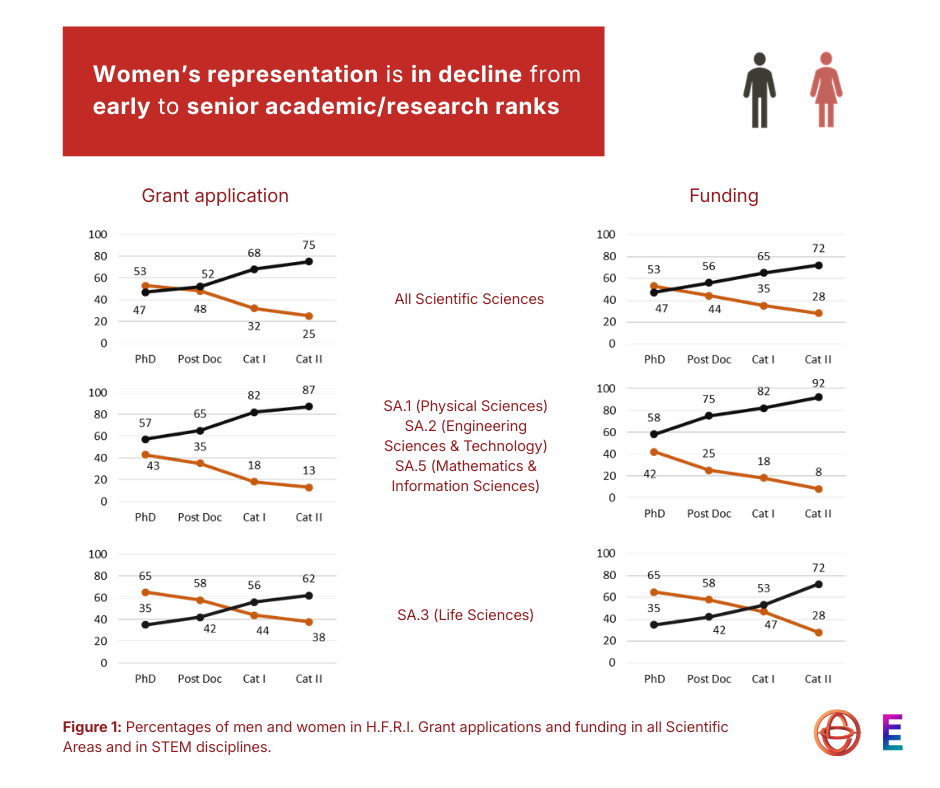
Women’s under-representation in Research and Innovation indicates structural and cultural barriers to academic advancement, such as biases in evaluation processes and ongoing challenges in balancing careers with family responsibilities, as documented at the European and international levels (She Figures). The case of Life Sciences, where women’s high presence at the early career stages is totally reversed at the senior level, emphasizes these barriers. Importantly, these patterns are also mirrored in research evaluation processes.
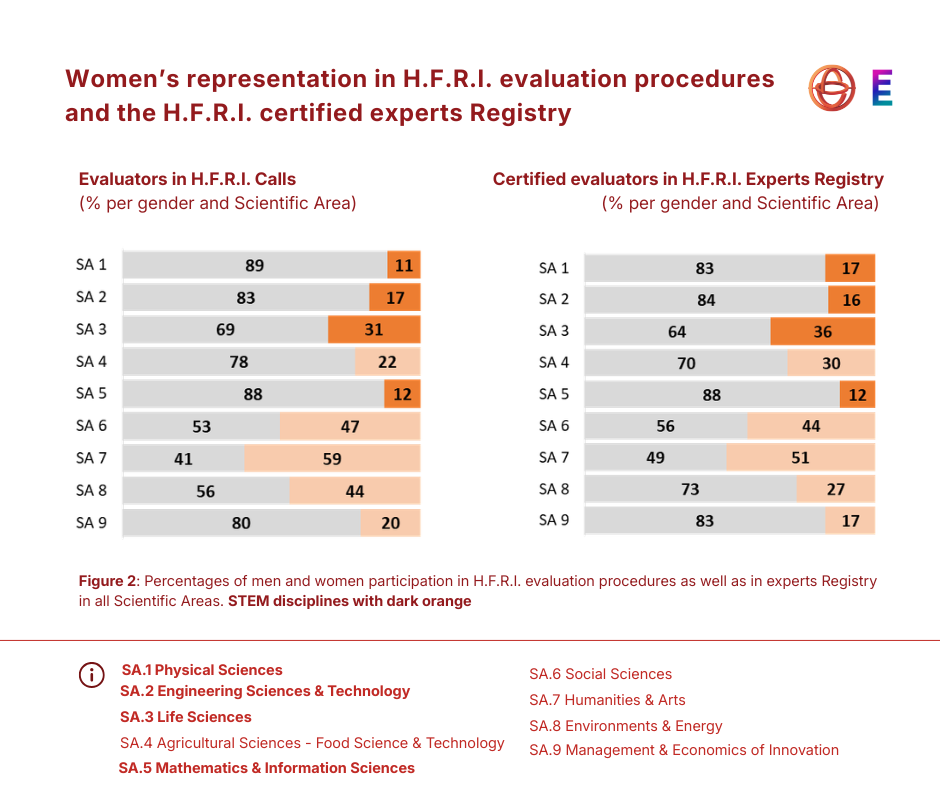
Evaluation plays a critical role in shaping research systems. Who evaluates research influences funding decisions, career progression and how excellence is defined. H.F.R.I.’s data reveal that women remain under-represented in evaluation panels and in the H.F.R.I.’s Registry, particularly in STEM disciplines (Fig. 2). This further underlines the need for targeted and sustained measures, aligned with the objectives of Horizon Europe and the development of Gender Equality Plans (GEPs).
Strengthening women’s participation in research evaluation is essential for fair, high-quality, and unbiased decision-making. Diverse expert panels help reduce gender bias, strengthen transparency and trust in funding processes, and encourage more women to step forward as principal investigators. At the same time, serving as an evaluator offers valuable professional benefits, including deeper insight into excellence criteria, strengthened critical assessment skills and increased confidence.
As part of its Gender Equality Plan and its participation in SEE-ERA program, H.F.R.I. seeks to make these disparities visible and implement targeted actions to mitigate them.
Therefore, H.F.R.I. invites women researchers to join its Certified Experts Registry and actively contribute to fair, transparent, and high-quality research evaluation.
Learn more: https://portal.hfri.gr/RegistrationArea/ArticleCategories
Διεύθυνση: Λεωφόρος Συγγρού 185 & Σάρδεων 2, 17121, Νέα Σμύρνη, Αθήνα
Τηλέφωνο επικοινωνίας: 210 64 12 410, 420
Email: info@elidek.gr



Όροι και Προϋποθέσεις Χρήσης Ιστότοπου
Πολιτική Προστασίας Δεδομένων του ιστοτόπου του ΕΛ.ΙΔ.Ε.Κ.
Copyright © ΕΛ.ΙΔ.Ε.Κ.


 Επικοινωνία