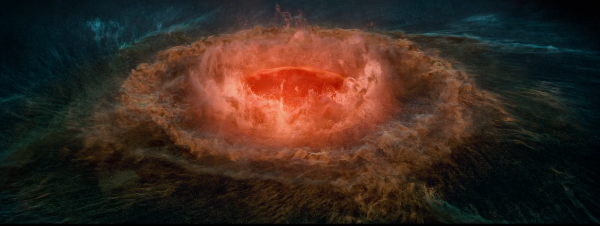
Study of the X-ray light flickering of quasars —supermassive black holes actively devouring matter— reveals powerful winds of outflowing material blasted away from the system and opens new opportunities for learning about the fierce and dynamic conditions in the inner regions of rapidly growing black holes.
An international team of astronomers made a surprising discovery concerning Quasars—supermassive black holes actively devouring matter— using new observations from the German eROSITA X-ray telescope. Contrary to previous expectations the study found that faster-feeding black holes demonstrate stronger X-ray flickering, i.e. more erratic variations of their X-ray brightness with time. The astronomers propose that this unexpectedly strong variability is caused by powerful winds of material blasting away from the black hole itself, which act like a “cosmic curtain”, intermittently blocking the X-ray light we observe. The new discovery was made possible by the new eROSITA observations of an unprecedentedly large sample of quasars. This unique dataset was analysed with novel statistical approaches that enabled the identification of subtle trends invisible to previous studies.
An international team of astronomers has made a surprising discovery: the flickering of the X-ray light emitted as supermassive black holes devour matter does not follow the expected patterns.
Most massive galaxies in the universe, including our own Milky Way, host at their centres black holes that weigh millions or even billions of times the mass of our Sun. The strong gravitational pull of these beasts captures matter, mostly gas, making it spiral inward and eventually fall in them, growing their masses even more.
Matter however, does not just disappear quietly. The intense gravity and friction heat it up to incredible temperatures, generating huge amounts of energy that is radiated away into space as brilliant light. It is this light that our telescopes can see. When a supermassive black hole is actively feeding and generating this powerful light show, we call it a Quasar. These objects are some of the brightest in the universe.
The light from Quasars has a special feature: it constantly flickers, or varies in brightness, over time. This is because the flow of matter onto the black hole is not perfectly steady. Random changes in the amount of material being eaten cause the Quasar’s light to flicker. Studying this flickering helps astronomers map the environment close to the black hole and understand how it consumes matter.
Previous research had found a clear pattern: the more massive the black hole, or the faster it feeds, the weaker the flickering of the emitted radiation was expected to be. A new study published in Monthly Notices of the Royal Astronomical Society challenges that established rule.
The team, led by researchers at the National Observatory of Athens, used new observations from the eROSITA X-ray telescope to monitor the time variations of the X-ray light from an unprecedented number of distant Quasars.
“Contrary to previous expectations, we found that the X-ray flickering actually becomes stronger for black holes that are accreting matter at a faster rate”, said Dr. Antonis Georgakakis from the National Observatory of Athens, the lead author of the study. “This new result tells us something fundamental about the flow of matter around rapidly-growing black holes.”
So, why the unexpected strong flicker? The astronomers propose that the answer lies in powerful winds of outflowing material produced by the Quasar itself.
The environment around rapidly growing black holes is thought to be violent and highly dynamic. The energy released as matter spirals into the black hole is so immense that it actually pushes some of the material away, creating powerful “winds” of gas and dust that blast outward. These winds are blowing out even as new material is spiraling in.
The ejected matter may act as a cloud or curtain, temporarily blocking the X-ray light generated by the accretion process and leading to the erratic X-ray flux variations we observe with our telescopes. This discovery offers a new way to study the fierce conditions in rapidly growing black holes.
The discovery was made possible by the eROSITA X-ray telescope operated by a consortium of German astronomy institutes. eROSITA is designed to repeatedly survey the entire sky every six months. This strategy provides the most sensitive X-ray observations ever over such vast areas. Since its launch, eROSITA has completed four full sky scans, providing astronomers with an unparalleled time-lapse view of the cosmos.
“These repeat observations track changes over time of the X-ray light intensity emitted by individual Quasars, making eROSITA the perfect tool to study the X-ray flickering as supermassive black holes devour matter”, reveals co-author Johannes Buchner, of the Max-Planck Institute of Extraterrestrial Physics.
The international team developed novel statistical methods to analyse the eROSITA data and make the most of these exceptional quality observations.
“Often, a source’s X-ray flux, as it changes over time, drops so low that it falls below eROSITA’s sensitivity limits, becoming effectively invisible and giving us only an upper limit of the flux rather than a precise measurement,” explains Maurizio Paolillo, professor at the University of Naples Federico II and co-author of the study. “Traditional analysis methods usually ignore this ‘hidden’ information. Our new statistical approach is specifically designed to exploit these upper limits, significantly improving our constraints on the variability properties of Quasars.”
The following video shows an artistic representation of a black hole at the center of the galaxy, which absorbs matter from its surroundings, releasing energy and light.
https://www.youtube.com/watch?v=1MXRhtPgEVE
The study was conducted as part of the research project entitled: “Forward-Modeling the Variable Energetic Universe” (4MOVE-U), which was supported by HFRI under the 2nd Call for Research Projects to Support Faculty Members and Researchers.
For more information about the project, visit its official website: https://4moveu.astro.noa.gr/
* Photo: Καλλιτεχνική αναπαράσταση του δυναμικού περιβάλλοντος μελανών οπών. Η ενέργεια που απελευθερώνεται καθώς ύλη περιδινίζεται προς τη μελανή οπή είναι δυνατό να δημιουργήσει ισχυρούς “ανέμους”, εκροές δηλαδή αερίου που παρασύρουν μέρος της ύλης του περιβάλλοντος των μελανών οπών και την εκτοξεύουν σε μεγάλες αποστάσεις. Credit: Dimitrios Sakkas (tomakti), Antonis Georgakakis, Angel Ruiz, Maria Chira (NOA).
Αddress: 185 Syggrou Ave. & Sardeon St. 2, 17121,
Nea Smyrni, Athens
Telephone: +30 210 64 12 410, 420
Email: info@elidek.gr







 Contact